
“Ten minutes of strength today protects decades of independence tomorrow.“
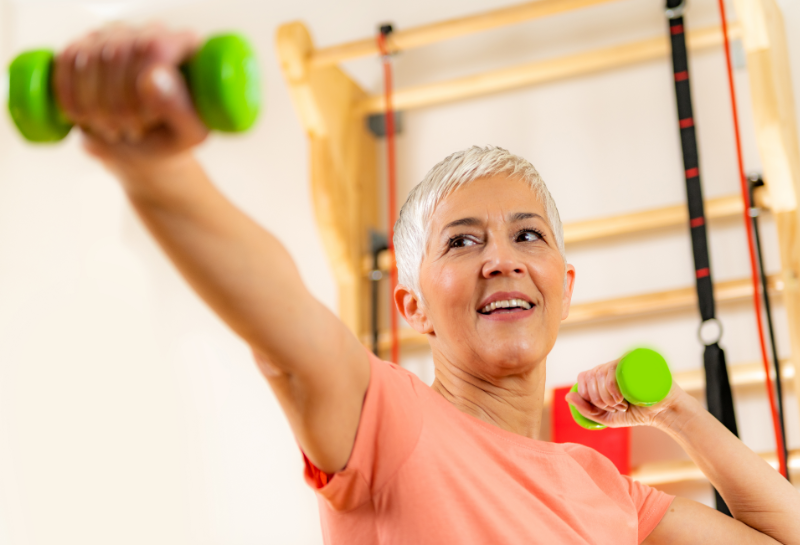
Most people over 60 are doing something for their health. They’re walking. They’re watching what they eat. They’re staying active. And yet, many of them are still losing strength — quietly, gradually, and without realising it until the warning signs become impossible to ignore.
Stairs that used to be effortless now require a hand on the railing. Getting up from a low chair takes noticeably more effort. Carrying groceries from the car feels heavier than it should. These are not random signs of aging — they are the early, measurable consequences of muscle loss. And aerobic exercise alone, no matter how consistently performed, cannot stop them.
The good news is that the solution is straightforward, backed by decades of clinical research, and requires no gym membership, no expensive equipment, and no more than 10 minutes at a time. This guide explains exactly what to do — and why it works. If you want to understand the full picture first, start with our article on why most people over 50 lose muscle and how to reverse it naturally.
Table of Contents
- Why Strength Training After 60 Matters
- The Role of Diet: Protein and Muscle After 60
- How Often Should You Do This Routine?
- The 10-Minute Strength Routine After 60
- How to Progress Safely
- When to Modify or Seek Professional Guidance
- Frequently Asked Questions
Why Strength Training After 60 Matters
Most people over 60 understand the importance of staying active. What is less well understood is that not all forms of physical activity are equivalent — and that aerobic exercise alone, including walking, cannot prevent the most consequential physiological change that occurs with aging: the loss of skeletal muscle mass.
Beginning around age 50 and accelerating significantly after 60, adults lose approximately 3–8% of muscle mass per decade. This process — known as sarcopenia — is not inevitable, but it is universal in the absence of a specific countermeasure. For a detailed look at the underlying mechanisms, see our guide on why most people over 50 lose muscle and how to reverse it naturally.
Skeletal muscle is not simply contractile tissue. It functions as a metabolically active organ that regulates blood glucose, synthesizes hormones, stabilizes joints, supports bone density, and determines how capable you remain across the full span of life. The consequences of untreated sarcopenia extend well beyond physical appearance:
- Increased susceptibility to falls and fractures
- Reduced insulin sensitivity and higher risk of type 2 diabetes
- Diminished neuromuscular coordination and reaction time
- Progressive loss of activities of daily living (ADLs)
- Greater dependence on assistive care and reduced quality of life
These changes often present subtly at first. Rising from a chair requires noticeably more effort. Ascending stairs becomes labored. Carrying moderate loads feels disproportionately difficult. These are not simply signs of ‘getting older’ — they are measurable, clinically recognized indicators of muscle decline. For a full breakdown of what to watch for, see our article on the early signs of muscle loss after 50.
Walking provides genuine cardiovascular, metabolic, and psychological benefits and should remain part of any active lifestyle. However, it does not generate sufficient mechanical load to stimulate muscle protein synthesis or prevent sarcopenia. For a thorough comparison of what each modality provides, see our breakdown of why strength training matters more than walking after 60. The conclusion is not that walking should be replaced — it is that resistance training must be added.
Resistance training provides the specific neuromuscular stimulus required for muscle fiber recruitment and protein synthesis. It is the only form of exercise that directly addresses sarcopenia. And critically, it remains effective well into advanced age — the neuromuscular system does not lose its capacity to respond to resistance stimulus simply because of age.
The Role of Diet: Protein and Muscle After 60

Resistance training provides the stimulus for muscle maintenance. Dietary protein provides the substrate. Both are necessary — neither is sufficient alone.
Older adults require more dietary protein than standard recommendations suggest. The widely cited RDA of 0.8 grams per kilogram of body weight was established for general population health maintenance, not for muscle preservation in aging adults. Current evidence from exercise physiology and nutrition research supports a target of 1.2–1.6 grams of protein per kilogram of body weight daily for adults over 60 who are engaged in resistance training.
Protein distribution across meals also matters. Muscle protein synthesis rates are optimized when protein intake is spread throughout the day rather than concentrated in a single meal. Aiming for 25–40 grams of high-quality protein per meal — from sources such as eggs, poultry, fish, dairy, or legumes — supports this. For a comprehensive guide to protein targets and food sources, see our article on how much protein you really need after 50.
Supplementation is not required if whole food intake meets these targets consistently. Whey protein and other complete protein supplements can be a practical option when dietary intake falls short, but they offer no advantage over food sources when total daily protein is adequate.
How Often Should You Do This Routine?
Current guidelines from the American College of Sports Medicine recommend resistance training two to three non-consecutive days per week for older adults. This frequency is sufficient to stimulate muscle maintenance and hypertrophy while allowing adequate recovery between sessions.
Each session in this routine is designed to be completed in approximately 10 minutes. While longer sessions can produce greater training volume, research consistently shows that short, frequent bouts of resistance exercise are highly effective — particularly for adults new to strength training or returning after a period of inactivity.
Training consistency is the primary driver of long-term outcomes. Frequency and adherence matter more than session duration or exercise complexity. A routine that is performed reliably twice a week for six months will produce significantly better outcomes than a more demanding program performed inconsistently.
For individuals currently engaged only in walking or other aerobic activity, adding resistance training two days per week represents a clinically meaningful intervention. The goal is not to replace aerobic exercise but to address the component of fitness it cannot provide.
The 10-Minute Strength Routine After 60
Perform the following five exercises in sequence. Prioritize controlled movement over speed. Rest briefly between exercises as needed. All movements can be completed at home without gym equipment, though a resistance band or light dumbbells are useful for exercises 4 and 5.
1. Sit-to-Stand (Chair Rise) — 2 Minutes
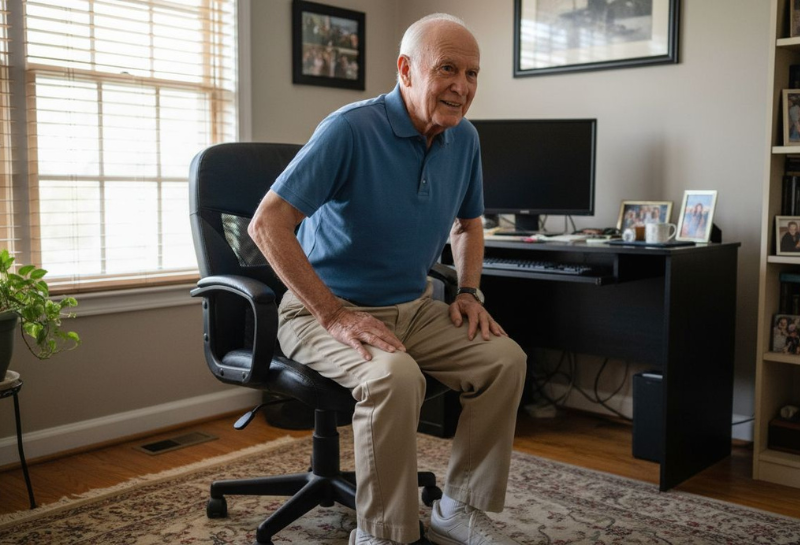
Works: The muscles in your thighs, backside, and core — the ones you rely on every time you get up from a seat.
How to do it:
- Sit in a stable chair with both feet flat on the floor, about hip-width apart
- Cross your arms over your chest, or hold them out in front for balance
- Push through your heels and stand up fully — don’t lean forward and lunge up
- Sit back down slowly and with control — don’t just drop back into the chair
- Keep going for the full 2 minutes, resting briefly if you need to
Why it matters: If getting up from a chair has started to feel like more effort than it used to, that’s one of the earliest signs your leg muscles are weakening. This exercise directly targets that. Doctors actually use a timed version of this movement to measure how well older adults are functioning — so every rep counts.
2. Wall Push-Up — 2 Minutes

Works: Your chest, shoulders, and the backs of your upper arms — the muscles that help you push, catch yourself, and maintain good posture.
How to do it:
- Stand facing a wall, about arm’s length away, with your palms flat against it at shoulder height and width
- Keep your body in a straight line from head to heels — don’t let your hips sag or stick out
- Bend your elbows and lower your chest toward the wall
- Push back to the start position
- As this gets easier, move to doing them against a countertop or table instead
Why it matters: Upper body strength is what allows you to catch yourself if you stumble. It also helps counteract the forward hunching that tends to develop with age — keeping you upright, reducing neck and shoulder strain, and making everyday reaching and pushing tasks easier.
3. Step-Up — 2 Minutes
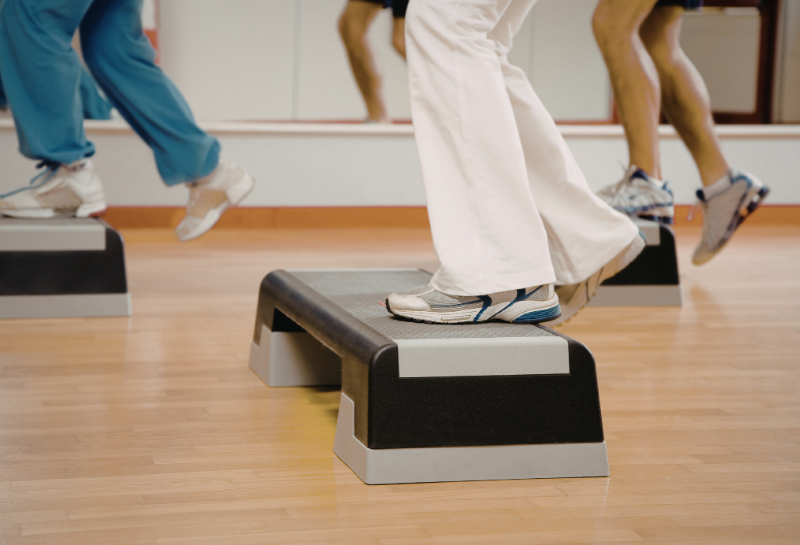
Works: Your legs and the muscles around your hips and ankles that keep you stable when you’re on one foot.
How to do it:
- Stand at the bottom of a staircase or in front of a low, sturdy step
- Step up with your right foot, then bring your left foot up to meet it
- Step back down, then lead with the left foot on the next rep — alternate each time
- Hold the railing or place a hand on the wall if you need support — that’s completely fine
Why it matters: Stairs become harder before flat walking does — and that’s because the explosive power needed to lift your body up a step fades faster than general muscle strength. This exercise trains exactly that. It also works each leg independently, which improves balance and stability in a way that most two-legged exercises simply don’t.
4. Resistance Band Row or Dumbbell Row — 2 Minutes
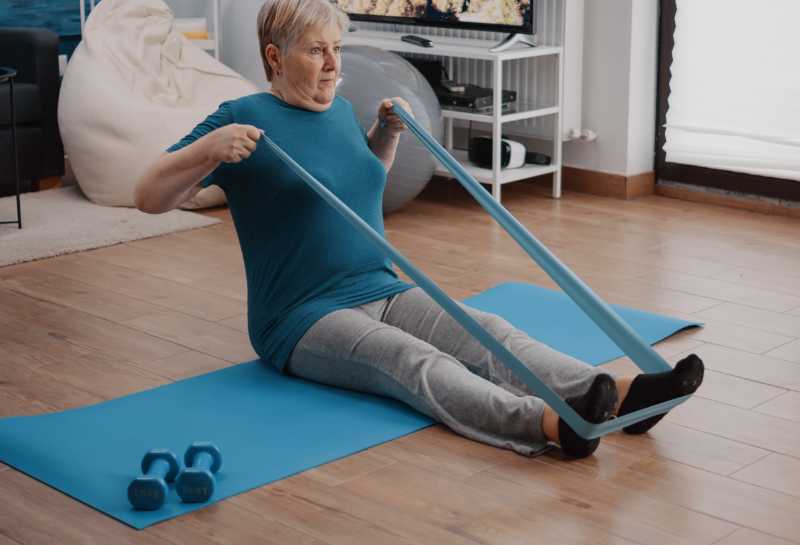
Works: The muscles across your upper back and the backs of your shoulders — the ones responsible for good posture and a strong, upright stance.
How to do it:
- Loop a resistance band around a door handle or sturdy post at chest height, or hold a light dumbbell in each hand
- Stand or sit tall with your arms extended in front of you
- Pull your elbows back, as if you’re trying to squeeze something between your shoulder blades
- Hold for a moment at the end, then slowly return to the start
- Keep the movement smooth and controlled throughout — no jerking
Why it matters: Most people’s upper backs are significantly weaker than the front of their body — and it shows in their posture. Rounded shoulders and a forward head position are very common after 60, and they lead to neck pain, shoulder problems, and a shuffling gait. Strengthening your upper back pulls everything back into alignment and keeps you standing tall.
5. Loaded Carry (Farmer’s Carry) — 2 Minutes
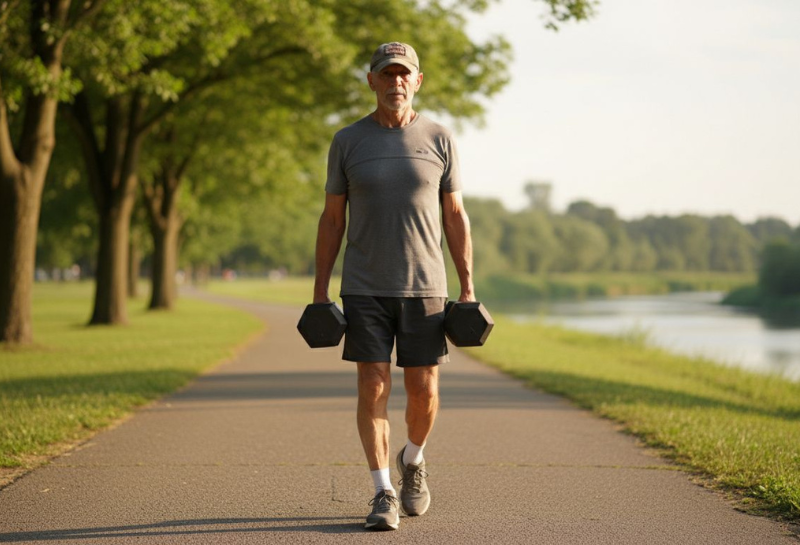
Works: Your grip, your core, and the muscles along your entire back and sides that keep you stable while carrying things.
How to do it:
- Hold a grocery bag, a filled water jug, or a light dumbbell in each hand
- Stand tall — shoulders back, eyes forward
- Walk slowly and steadily for the full 2 minutes
- Don’t let yourself lean to one side — keep your body upright throughout
- Start light and build up gradually as it becomes easier
Why it matters: Grip strength turns out to be one of the best overall indicators of how healthy your muscles are — and how long you’re likely to stay independent. If carrying shopping has started to feel harder, that’s worth paying attention to. This exercise also forces your core and back muscles to work hard just to keep you upright, which directly translates to stability in everyday life.
Total session time: 10 minutes | Equipment: None required (optional: resistance band or light dumbbells for exercises 4 and 5)
How to Progress Safely
Progressive overload — the practice of gradually increasing the training stimulus over time — is the mechanism by which muscle adapts and strengthens. The body responds to a challenge slightly beyond its current capacity; without progression, adaptation plateaus.
After two to three weeks of consistent training at the initial level, apply one or more of the following progressions:
- Increase the number of repetitions completed within each interval
- Slow the eccentric (lowering or returning) phase of each movement to 3–4 seconds
- Add an additional circuit following the main sequence
- Increase resistance — a heavier band, additional weight, or a higher step
- Reduce rest time between exercises
Avoid large or rapid increases in load or volume. Muscle tissue adapts quickly to training stimulus, but connective tissue — tendons and ligaments — requires considerably more time. Progressing too aggressively is the most common cause of training-related injury in older adults returning to exercise. Consistent, incremental progression over weeks and months produces superior long-term outcomes.
Adequate dietary protein remains essential throughout progression. As training intensity increases, so does the demand for muscle protein synthesis. Review our guide on protein needs after 50 if you are unsure whether your current intake supports your training.
When to Modify or Seek Professional Guidance
Resistance training is safe for the vast majority of older adults, including those with chronic conditions such as osteoarthritis, hypertension, or type 2 diabetes — in many cases, it is directly therapeutic. However, certain symptoms warrant modification or professional consultation before continuing.
Discontinue exercise and consult your physician or a licensed physical therapist if you experience any of the following during or after training:
- Acute or sharp joint pain (distinct from normal muscular exertion or delayed onset muscle soreness)
- Dizziness, lightheadedness, or chest discomfort during or immediately following exercise
- Significant instability or loss of balance that represents a change from your baseline
- Persistent muscle soreness lasting more than 72 hours following a session
- Any new neurological symptoms, including numbness, tingling, or unexplained weakness
Even one to two sessions with a physical therapist or certified strength and conditioning specialist can be highly valuable — particularly for individuals new to resistance training, managing joint conditions, or recovering from injury. A qualified professional can identify compensatory movement patterns, establish appropriate starting loads, and build the movement confidence that supports long-term adherence.
Frequently Asked Questions
Is 10 minutes of strength training per session clinically meaningful?
Yes, when performed consistently and with appropriate intensity. Research demonstrates that short-duration resistance training sessions completed two to three times per week can meaningfully attenuate sarcopenia and improve functional outcomes in older adults. Frequency and adherence are the primary determinants of long-term benefit — not session duration.
Does walking provide sufficient resistance stimulus for muscle maintenance?
No. Walking provides cardiovascular, metabolic, and bone-loading benefits, but it does not generate sufficient mechanical load to stimulate muscle protein synthesis or prevent age-related muscle fiber atrophy. For a full explanation of what each modality provides and why both are necessary, see our article on why strength training matters more than walking after 60.
Can adults over 70 build meaningful muscle through resistance training?
Yes. Controlled trials consistently demonstrate that adults in their 70s and 80s are capable of significant strength and hypertrophy gains in response to progressive resistance training. The neuromuscular system retains plasticity well into advanced age. Initial gains often reflect improved motor unit recruitment — the brain becoming more efficient at activating existing muscle fibers — followed by structural hypertrophy over 8–12 weeks and beyond.
How much protein is required to support muscle maintenance after 60?
Current evidence supports 1.2–1.6 grams of protein per kilogram of body weight daily for older adults engaged in resistance training. This exceeds the standard RDA (0.8 g/kg), which is widely considered insufficient for sarcopenia prevention. Distributing protein intake across meals — rather than concentrating it in one sitting — also improves muscle protein synthesis rates. For detailed guidance on sources and targets, see our full guide on protein needs after 50.
What are the earliest signs that muscle loss is already occurring?
Common early indicators include increased difficulty rising from a low chair without using arm support, reduced grip strength, stairs feeling significantly more effortful than they previously did, and carrying moderate loads feeling disproportionately heavy. These functional changes typically precede visible changes in body composition by months or years. For a comprehensive breakdown, see our guide on the early signs of muscle loss after 50.
When can I expect to notice results?
Subjective improvements in strength, stability, and ease of daily tasks are commonly reported within 4–6 weeks of consistent training. Early gains are primarily neurological — the central nervous system becomes more efficient at recruiting existing muscle fibers. Structural muscle changes (hypertrophy) develop over a longer horizon of 8–12 weeks and beyond, becoming more apparent with continued progressive overload.
Summary

Muscle loss after 60 is common. It is not inevitable.
The human neuromuscular system responds to resistance stimulus across the full lifespan. A 10-minute resistance routine, performed consistently two to three times per week, provides sufficient stimulus to slow sarcopenia, preserve functional independence, and reduce fall risk. Paired with adequate protein intake — as outlined in our guide on protein needs after 50 — it forms the foundation of a strategy for aging powerfully rather than passively.
No gym is required. No specialized equipment is required. What is required is consistency — and the understanding that aerobic activity and resistance training address fundamentally different physiological systems, both of which matter for healthy aging.
If you have not yet read our full breakdown of why most people over 50 lose muscle and how to reverse it naturally, that is the recommended next step. Understanding the mechanism makes the intervention make sense.

