
“Muscle loss whispers long before it shouts.”
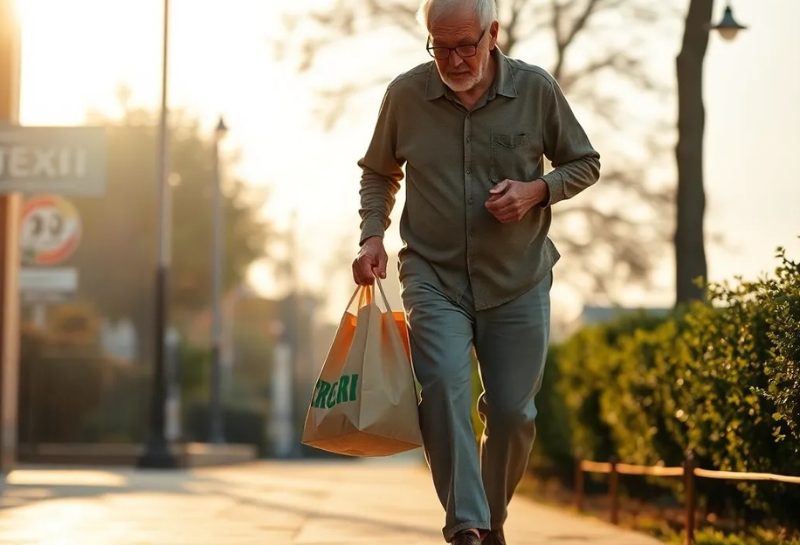
Muscle loss rarely announces itself. It doesn’t arrive with a dramatic injury or a sudden collapse in strength. Instead, it shows up quietly — in small moments you might barely notice.
Standing up takes an extra second. Stairs feel slightly steeper. The grocery bags feel heavier than they used to.
After 50 — and especially after 60 — these subtle changes can signal the beginning of age-related muscle decline. And while they may seem minor in isolation, the early signs of muscle loss are your body’s way of telling you something important before the problem becomes harder to reverse.
The good news? Muscle loss is common — but it is not inevitable. With the right approach, you can slow it down, stop it, and even reverse it at any age.
This guide walks you through six early warning signs of muscle loss, explains why each one matters, and outlines what you can do about them starting today.
What Causes Muscle Loss After 50?
Age-related muscle loss has a clinical name: sarcopenia. It begins subtly in your 30s and accelerates significantly after the age of 50. Research estimates that adults lose between 3 and 8 percent of muscle mass per decade after 30, with the rate of decline increasing sharply after 60.
But here’s what most people don’t realize: muscle strength tends to decline faster than muscle size. That means you may not look dramatically different in the mirror — but you could already be losing functional strength that affects how you move, balance, and recover from everyday physical demands.
If you’d like a deeper breakdown of how sarcopenia develops, why it accelerates after 50, and what the research says about reversing it, read our full guide on muscle loss after 50.
The Key Drivers of Sarcopenia
Several interrelated factors accelerate muscle loss as we age:
- Reduced resistance stimulus — without regular strength challenges, the body has no reason to maintain muscle tissue
- Anabolic resistance — muscles become less responsive to the protein you eat, making it harder to repair and build
- Loss of fast-twitch muscle fibers — the powerful fibers needed for explosive movements decline fastest
- Lower physical demand in daily life — many people naturally become less active, reducing the movement-based stimulus that preserves muscle
- Hormonal shifts — declining testosterone and estrogen levels affect how efficiently the body builds and maintains lean tissue
| Why This Matters Muscle is not cosmetic tissue. It is a metabolic organ that regulates blood sugar, supports bone density, stabilizes joints, and directly determines whether you can live independently as you age. |
Now let’s look at the six early signs of muscle loss that you should watch for — and take seriously.
Sign #1: Standing Up Feels Slower or Harder
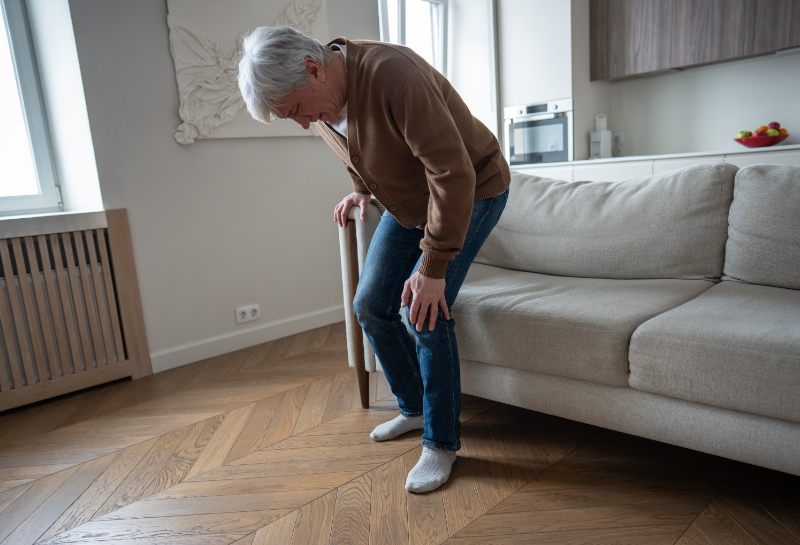
One of the earliest and most telling indicators of muscle decline is difficulty rising from a seated position. This is especially noticeable when getting up from a low chair, a couch, or the floor.
If you find yourself rocking forward to build momentum before you stand, using your hands to push off your thighs or armrests, taking longer to fully straighten up, or needing to pause before moving, your body is compensating for reduced strength in the muscles that power this movement.
The sit-to-stand motion relies primarily on the quadriceps, glutes, and core stabilizers — muscle groups that are among the first to show measurable decline without regular resistance training. This is not simply “getting older.” It is under-stimulation. The muscles are there. They are simply not being asked to work hard enough to stay strong.
| Quick Self-Test Sit in a standard chair with your arms crossed over your chest. Try to stand up five times in a row as quickly as you can. If this feels difficult or unstable, it may be worth discussing with your doctor or starting a lower-body strength program. |
Sign #2: Climbing Stairs Feels More Difficult Than It Used To
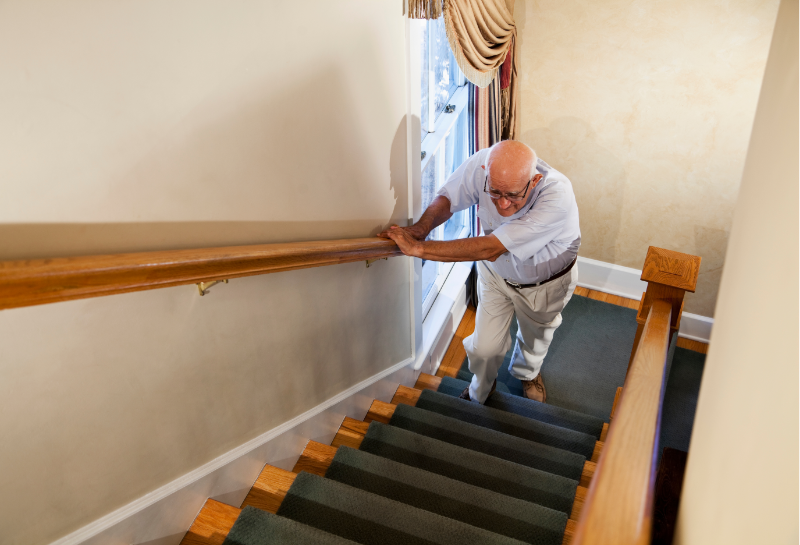
Walking on flat ground requires relatively little muscle power. Stairs are different. Climbing stairs demands explosive strength from your lower body — specifically the fast-twitch muscle fibers in your quads, hamstrings, glutes, and calves.
Fast-twitch fibers are the first to decline with age, and they are the ones responsible for power, speed, and stability. If stairs have started to feel harder than they did even a year ago — leaving you more winded, requiring you to hold the railing for balance, causing hesitation at the top or bottom, or making your legs feel heavy and unsteady — that is a meaningful early sign of muscle loss worth paying attention to.
Walking trains endurance. Stairs expose strength deficits. They are two very different physical demands, and treating one as a substitute for the other is a common and costly mistake after 50.
Sign #3: Your Balance Feels Slightly Off
Balance is one of those things we take for granted until it starts to slip. And the slipping is almost always gradual.
You may not be falling. But you might notice that you feel less confident walking on uneven surfaces, that you stumble more easily than you used to, that you reach out to steady yourself on walls or furniture, or that recovering from a stumble takes more effort.
Balance is not purely neurological. It is deeply muscular. The ability to stabilize yourself quickly after a slip or stumble depends on the rapid activation of hip muscles, calves, core stabilizers, and the small proprioceptive muscles in your feet and ankles. When these muscles weaken, your reaction time slows — and your risk of a fall increases substantially.
Falls are the leading cause of injury-related death among adults over 65. But they rarely happen “out of nowhere.” They typically follow months or years of gradual, undetected strength decline. Identifying and addressing the early signs of muscle loss is one of the most effective fall-prevention strategies available.
Sign #4: You Avoid Getting Up From the Floor
This sign is subtle — but it is one of the most powerful predictors of functional decline.
Pay attention to whether you find yourself thinking twice before sitting on the floor, avoiding positions that require you to get back up unassisted, feeling genuinely uncertain about whether you can get up if you go down, or automatically looking for something to hold onto before attempting it.
Getting up from the floor without assistance is a remarkably demanding movement. It requires coordinated leg drive, core stability, upper-body pushing strength, and full-body coordination. Research has shown that the ability to sit and rise from the floor — sometimes called the “sitting-rising test” — is a strong predictor of all-cause mortality in middle-aged and older adults.
If this movement feels uncertain or intimidating, it is a clear signal that your overall functional strength has declined enough to warrant immediate attention.
Sign #5: You Carry Less Than You Used To
Think about how you handle groceries, luggage, tools, or any regular load you carry in daily life. Have you started making more trips to avoid carrying everything at once? Do heavy bags feel harder to hold? Do you set things down more quickly than you used to? Have you started choosing the lighter option when available?
Grip strength and carrying capacity are among the most reliable clinical markers of overall muscle health. In fact, grip strength is routinely used in research settings and medical assessments as a proxy for systemic muscle function and as a predictor of frailty risk.
The muscles of the hands, forearms, and shoulders do not decline in isolation. When these muscles weaken, it is almost always a reflection of broader systemic decline — not just a local issue. If everyday loads are starting to feel heavier than they used to, your body may be sending you an important message.
Sign #6: You Feel Weaker, But Can’t Explain Why
This is often the first sign — and the hardest to pin down.
You have not been ill. You have not changed your diet dramatically. You have not had an injury. But you feel noticeably less strong than you did a year or two ago. Everyday tasks feel slightly harder. You tire more quickly. Your body feels less capable than your mind expects it to be.
That gap between perceived and actual capability is a hallmark of early sarcopenia. Strength is not merely a function of muscle size — it is your nervous system’s ability to recruit and coordinate muscle fibers rapidly and efficiently. Without regular resistance challenges, that neuromuscular connection weakens. The muscle fibers are still there, but the brain-muscle communication that makes them powerful becomes less efficient.
This is one of the most important early signs of muscle loss to take seriously precisely because it is easy to dismiss as “just aging.” It is not just aging. It is a trainable, reversible process.
Why These Early Signs of Muscle Loss Matter Beyond Strength
Muscle decline is about much more than how strong you feel at the gym. Muscle tissue is metabolically active and systemically important in ways that most people do not fully appreciate until something goes wrong.
Higher muscle mass is associated with better blood sugar regulation, stronger bones and reduced fracture risk, greater joint stability and reduced arthritis pain, faster recovery from illness or surgery, and lower all-cause mortality. It is not an exaggeration to say that preserving your muscle mass after 50 is one of the most powerful investments you can make in your long-term health and independence.
Cardiovascular fitness protects your heart. Muscle mass protects everything else.
How to Reverse Early Muscle Loss: What Actually Works
The solution to the early signs of muscle loss is not extreme. It does not require hours in the gym or heavy barbell training. But it does require intentionality and consistency. Here is what the evidence supports:
1. Resistance Training Two to Three Times Per Week
This is non-negotiable. Walking, swimming, and cycling are valuable for cardiovascular health — but they do not provide the resistance stimulus your muscles need to maintain and grow. Progressive resistance training is the only intervention proven to directly counter sarcopenia.
Even 20-minute sessions two or three times per week can produce measurable improvements in strength, balance, and muscle mass. You do not need a gym membership. Bodyweight exercises, resistance bands, and simple household items can all be sufficient starting points.
Effective exercises for beginners include sit-to-stands from a chair, wall push-ups or floor push-ups, step-ups onto a low step or stair, resistance band rows or presses, and farmer’s carries with grocery bags or light dumbbells.
Start conservatively, focus on form, and increase the challenge gradually. The goal is progressive overload — consistently asking your muscles to do slightly more than they are comfortable with.

2. Increase Your Protein Intake
After 50, muscles become less responsive to dietary protein — a phenomenon known as anabolic resistance. As a result, older adults need more protein than younger adults to achieve the same muscle-building response.
Most research suggests that adults over 50 benefit from consuming between 1.0 and 1.6 grams of protein per kilogram of body weight per day, spread across meals to maximize absorption. Prioritize high-quality protein sources such as eggs, chicken, fish, Greek yogurt, cottage cheese, legumes, and protein-rich plant foods.
Resistance training provides the stimulus. Protein provides the building blocks. You need both.
If you’re unsure how much protein you personally need or how to distribute it across meals, see our detailed guide on how much protein adults over 50 actually require to maintain muscle.
3. Prioritize Consistency Over Intensity
One of the most common mistakes people make when they recognize the early signs of muscle loss is trying to do too much too quickly. Soreness, injury, and burnout are the predictable results — and they derail the consistency that actually produces results.
Start with what you can sustain. Two sessions per week done consistently for six months will produce far greater results than five sessions per week for three weeks followed by nothing. The body adapts to resistance at any age. The process simply requires patience and regularity.
4. Consider Consulting a Professional
If you are new to resistance training, have existing joint issues, or are unsure where to begin, a session or two with a physical therapist or certified personal trainer experienced in working with older adults can be an excellent investment. The goal is to build a sustainable foundation — not to follow a generic program that may not account for your specific needs and limitations.
Frequently Asked Questions About Early Signs of Muscle Loss
At what age do the early signs of muscle loss typically appear?
Muscle loss begins gradually in your 30s, but the early signs of muscle loss most commonly become noticeable in your 50s. After 60, the rate of decline accelerates significantly without regular resistance training.
Can you rebuild muscle after 60 or 70?
Yes — and the research on this point is consistent and compelling. Adults in their 60s, 70s, and even 80s can increase muscle mass and strength with progressive resistance training. The rate of gain may be slower than in younger adults, but the capacity for meaningful improvement remains throughout life.
Is walking enough to prevent the early signs of muscle loss?
Walking is excellent for cardiovascular health and general wellbeing, but it does not provide sufficient resistance stimulus to preserve muscle mass. Preventing sarcopenia requires progressive resistance training in addition to aerobic exercise.
How quickly can strength training reverse early muscle loss?
Many people notice meaningful improvements in strength, balance, and energy within four to eight weeks of beginning a consistent resistance training program. Measurable gains in muscle mass typically follow within eight to twelve weeks. The timeline varies depending on starting point, consistency, and nutrition.
What is the difference between normal aging and sarcopenia?
Some degree of strength decline is a natural part of aging. Sarcopenia is the clinical term for the accelerated, progressive loss of muscle mass and function that goes beyond what is considered normal — and that meaningfully impairs physical function, independence, and quality of life. The early signs of muscle loss described in this guide may indicate the beginning of sarcopenia, particularly if multiple signs are present.
Final Thoughts

Muscle loss does not happen overnight. It whispers long before it shouts. The early signs of muscle loss are easy to explain away, easy to attribute to a bad week or a change in sleep, easy to decide are not worth worrying about yet.
But each of the six signs described here is a signal. Not a reason to panic — but a reason to act. Because the earlier you respond to the early signs of muscle loss, the easier it is to reverse course. And the longer you wait, the harder recovery becomes.
Your body still responds to resistance at 50, at 60, at 70, and beyond. It still builds strength when asked. It still protects the muscle you use. The window is not closed. It is simply waiting for you to open it.
Live healthier. Live stronger. Live longer.

