
“If you want to stay strong after 50, you have to feed strength intentionally.”

Protein after 50 becomes one of the most important — and most overlooked — factors in preserving muscle and strength.
Most people over 50 don’t realize they’re losing muscle because of something they’re not eating enough of.
It’s not a disease. It’s not genetics.
It’s protein — and most adults over 50 aren’t getting nearly enough to protect their muscle mass.
The protein intake that worked in your 30s isn’t enough anymore. Your body changes the rules after 50, and your muscles become less responsive to the same amount of protein. The result? Gradual muscle loss, declining strength, and eventually, loss of independence.
Research shows exactly how much protein you need — and it’s more than the standard recommendation suggests.
Let’s break down what the science actually says.
Table of Contents
- Why Protein Needs Change After 50
- What Is Anabolic Resistance?
- How Much Protein Do Adults Over 50 Need?
- How Much Protein Per Meal?
- Best Protein Sources After 50
- Is Too Much Protein Harmful?
- How Protein Fits Into the Bigger Picture
- What You Can Do Today
- Frequently Asked Questions
Why Protein Needs Change After 50
Your muscles become less responsive to protein as you age.
This process, called sarcopenia, is the progressive loss of muscle mass and function that accelerates after 50. The European Working Group on Sarcopenia in Older People has documented how aging fundamentally changes the way your body processes protein.
https://pubmed.ncbi.nlm.nih.gov/30312372/
Here’s what happens:
In your 30s, eating 15-20 grams of protein at breakfast triggers muscle repair effectively.
In your 60s, that same amount barely stimulates muscle growth.
This isn’t about willpower or effort. It’s basic biology. Your muscle cells develop what researchers call “anabolic resistance” — a reduced ability to respond to dietary protein and build new muscle tissue.
The practical impact:
- Smaller protein portions no longer support muscle maintenance
- Skipping protein at any meal costs you more than it used to
- Uneven protein distribution throughout the day leaves muscle repair incomplete
For example, if someone in their 60s eats 80 grams of protein but consumes 60 grams at dinner and almost none at breakfast, they’re missing opportunities for muscle repair throughout the day.
Most adults over 50 are losing muscle not because they eat poorly, but because they eat like they’re still 35.

What Is Anabolic Resistance?
Anabolic resistance is your body’s declining ability to turn dietary protein into muscle.
Research suggests that older adults need significantly higher protein doses per meal to achieve the same muscle protein synthesis response as younger adults.
https://pubmed.ncbi.nlm.nih.gov/23867520/
When you eat protein, amino acids signal your muscle cells to start building and repairing tissue. In younger people, even modest amounts of protein trigger this response effectively.
After 50, that signaling pathway becomes less sensitive. You need a stronger stimulus — more protein — to get the same result.
This doesn’t mean you need to double your protein intake.
It means you need to be more strategic about:
- How much protein you eat per meal
- When you eat it throughout the day
- What type of protein sources you choose
The goal isn’t eating more food overall. It’s optimizing protein distribution and quality.
How Much Protein Do Adults Over 50 Need?
The standard recommendation falls short.
The RDA (Recommended Dietary Allowance) for protein is 0.8 grams per kilogram of body weight per day. But that number was designed to prevent deficiency — not optimize muscle health in aging adults.
Evidence indicates that active older adults need more:
1.0–1.6 grams per kilogram per day
https://pubmed.ncbi.nlm.nih.gov/23867520/
This recommendation comes from extensive research on protein metabolism and muscle preservation, including the PROT-AGE Study Group — an international panel of researchers focused on optimal nutrition for older adults.
What That Looks Like in Real Numbers
For a 150-pound (68 kg) adult:
- Old RDA: ~55 grams per day (insufficient for muscle preservation)
- Evidence-based range: 68–110 grams per day
For a 180-pound (82 kg) adult:
- Evidence-based range: 82–130 grams per day
For a 200-pound (91 kg) adult:
- Evidence-based range: 91–145 grams per day
These ranges account for activity level, body composition, and individual response to protein.
Studies show that most people over 50 fall well below these targets — especially women, who often consume only 40-60 grams per day.
That gap compounds over time. Every day of inadequate protein means less muscle repair, less strength, and greater vulnerability to functional decline.
How Much Protein Per Meal?
Total daily protein matters. But distribution matters just as much.
Research shows that muscle protein synthesis maxes out around 25–40 grams per meal in older adults. Eating 100 grams of protein at dinner and almost none at breakfast means you’re leaving muscle-building potential on the table.
The Better Approach: Even Distribution
Spread your protein across three meals:
Example for 90-100g daily target:
- Breakfast: 30g
- Lunch: 30g
- Dinner: 30g
This approach keeps muscle protein synthesis elevated throughout the day — not just after your evening meal.
Think of it like watering a plant. One large flood doesn’t work as well as consistent, regular watering throughout the day.
For example, if someone eats oatmeal for breakfast (5g protein), a small salad for lunch (8g protein), and a large steak dinner (60g protein), they’ve met their daily total but missed two opportunities for muscle repair.
Your muscles need steady protein signals to maintain and build tissue, especially as anabolic resistance increases with age.
Best Protein Sources After 50
Not all protein is equal.
What matters most is amino acid profile — specifically, the essential amino acids your body can’t produce on its own.
The key player is leucine. Leucine is the primary trigger for muscle protein synthesis. Protein sources rich in leucine are particularly effective for overcoming anabolic resistance in older adults.
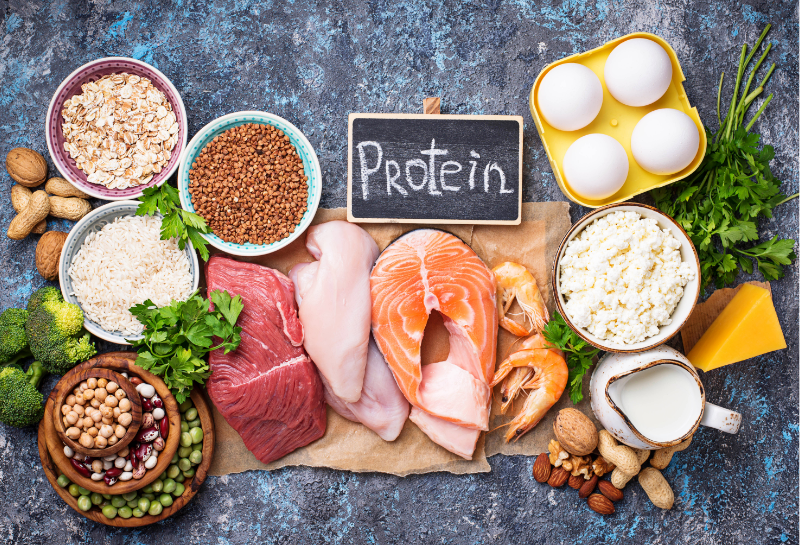
High-Quality Protein Sources
Animal-Based (highest leucine content):
- Eggs: 6–7g per egg
- Greek yogurt: 15–20g per cup
- Cottage cheese: 12–15g per half cup
- Chicken or turkey breast: 25–30g per 3 oz
- Fish (salmon, tuna, cod): 20–25g per 3 oz
- Lean beef: 22–25g per 3 oz
- Whey protein: 20–25g per scoop
Plant-Based (combine sources for complete profiles):
- Lentils: 18g per cooked cup
- Chickpeas: 15g per cooked cup
- Tofu: 10g per half cup
- Quinoa: 8g per cooked cup
- Edamame: 17g per cooked cup
- Plant protein blends: 20–25g per scoop
Whole-food sources should be your foundation. Protein powders aren’t a shortcut — they’re a practical tool when whole foods alone don’t get you to your target.
The key is quality and consistency, not perfection.
Is Too Much Protein Harmful?
One of the most persistent myths: protein damages your kidneys.
For healthy adults without preexisting kidney disease, protein intake in the 1.0–1.6 g/kg range is safe. Extensive research has failed to show kidney damage from moderate protein increases in people with normal kidney function.
The confusion comes from a real concern:
People with diagnosed kidney disease do need to limit protein. But that’s a specific medical condition — not a reason for healthy adults to fear adequate protein.
Evidence indicates that for most people over 50, inadequate protein is far more dangerous than consuming recommended amounts.

The real risks of low protein:
- Accelerated muscle loss
- Increased frailty
- Higher fall risk
- Slower recovery from illness or surgery
- Loss of independence
If you have kidney disease or concerns about kidney function, work with your healthcare provider. For everyone else, adequate protein within recommended ranges is protective — not harmful.
How Protein Fits Into the Bigger Picture
Protein alone won’t save your muscle.
It’s one piece of a larger system that includes:
1. Resistance Training
Without the stimulus of lifting weights or resistance exercise, protein has limited muscle-building effect. Training tells your body “we need this muscle.” Protein provides the raw materials to build it.
Research consistently shows that resistance training amplifies the muscle-building response to protein intake. The combination is exponentially more powerful than either alone.
2. Adequate Sleep
Muscle repair happens during sleep. Shortchange your sleep, and you shortchange your recovery — no matter how much protein you eat.
3. Consistent Movement
Daily activity keeps your metabolism active and supports protein utilization. Sedentary lifestyles reduce the anabolic response to protein.
4. Recovery Time
Your muscles need time between training sessions to rebuild. Protein supports this process, but rest is when the actual adaptation happens.
For example, if someone eats adequate protein but sits most of the day and never challenges their muscles with resistance, they’ll still lose muscle mass over time.
If you haven’t explored our guide on muscle loss after 50, that’s where you’ll find the complete picture of how strength decline happens — and how to reverse it.

What You Can Do Today
Start with these practical steps:
1. Calculate your protein target
- Multiply your weight in pounds by 0.6 to 0.8 (that’s roughly 1.2–1.6 g/kg)
- Example: 160 lbs × 0.6 = 96 grams per day minimum
2. Distribute protein across three meals
- Aim for 25-35 grams per meal
- Don’t save it all for dinner
3. Choose high-quality protein sources
- Prioritize animal proteins or complete plant protein combinations
- Focus on leucine-rich options
4. Track for one week
- Use a simple app or food journal
- Most people are surprised how little they actually consume
5. Adjust gradually
- Don’t jump from 50g to 100g overnight
- Build up over 2-3 weeks as your appetite adjusts
6. Pair with resistance training
- Even bodyweight exercises count
- 2-3 sessions per week makes protein work harder
Small daily actions compound. Consistency beats perfection.
⸻
If you prefer watching this explained step-by-step, including practical meal examples and how to build this into your routine, I break it down in detail on the Live Long Naturally YouTube channel.
⸻
Final Thoughts
After 50, protein becomes more than a macronutrient. It becomes the foundation of independence.
Every meal is an opportunity to signal your body: “We’re keeping this muscle. We’re staying strong.”
The science is clear. The strategy is straightforward:
Eat 1.0–1.6g of protein per kilogram of body weight daily
Distribute it evenly across three meals
Combine it with resistance training
Be consistent
You don’t need perfect execution. You need persistent effort.
Muscle responds to what you do consistently — not what you do occasionally. Most people over 50 aren’t eating enough protein. They’re not weak. They’re under-fueled.
Change the fuel, change the outcome.
Small daily actions matter. Start today.
Live healthier.
Live stronger.
Live longer.
Frequently Asked Questions
Does protein build muscle without exercise?
Protein supports muscle maintenance and repair, but resistance training provides the primary stimulus for muscle growth. Without training, adequate protein helps preserve existing muscle but won’t add significant new tissue.
Studies show that combining protein with resistance exercise produces far better results than either intervention alone.
Is plant protein effective after 50?
Yes, but with considerations. Plant proteins typically have lower leucine content and may lack one or more essential amino acids.
To get the same muscle-building effect, you may need:
- Slightly higher total protein intake (closer to 1.4-1.6 g/kg)
- Combinations of plant sources (rice + beans, hummus + whole grain)
- Plant protein supplements that blend sources for complete profiles
Research suggests that with proper planning, plant-based diets can support muscle health in older adults.
Should I eat protein before or after exercise?
Both can work. The “anabolic window” isn’t as narrow as once thought. What matters most is getting adequate protein within a few hours of training and meeting your daily target.
Evidence indicates that consistency matters more than precise timing. Don’t stress perfect timing — focus on hitting your daily distribution goals.
Can you eat too much protein in one meal?
Your body can digest and use large amounts of protein, but for muscle building specifically, there’s diminishing returns above 40-50 grams per meal for older adults.
Research shows that spreading protein across meals appears more effective than concentrating it in one or two large doses.
What if I’m not hungry enough to eat that much protein?
Start with these strategies:
- Prioritize protein first at each meal — eat it before filling up on other foods
- Choose calorie-dense protein sources like salmon, eggs, and Greek yogurt
- Use liquid calories via protein shakes if solid food is difficult
- Build gradually — don’t make drastic changes overnight
Your appetite often adjusts over 2-3 weeks as your body adapts. For example, if you currently eat 50 grams daily, aim for 65 grams for two weeks, then increase again.
How often should older adults eat protein?
Evidence suggests that spreading protein across three meals (rather than one or two large meals) better supports muscle protein synthesis throughout the day.
Each meal should contain 25-40 grams of high-quality protein for optimal muscle maintenance.
Is it too late to start if I’m already 60 or 70?
Research shows that older adults can still build muscle and improve strength at any age with proper nutrition and resistance training. The principles remain the same — adequate protein, consistent training, and patience.
Studies on adults in their 70s, 80s, and even 90s show meaningful strength gains with appropriate intervention.

