
“Muscle isn’t just about strength — it’s your insurance policy for independence.”

Muscle loss after 50 doesn’t happen overnight. Strength fades quietly, almost imperceptibly—until one day you notice standing up from a chair takes an extra beat, grocery bags feel heavier, or your balance isn’t quite what it used to be.
Maybe you find yourself using momentum to get out of low chairs. Or you grab the railing on stairs you used to bound up effortlessly. Perhaps you’ve stopped carrying multiple bags from the car in one trip, or you notice your legs feel less stable after sitting through a long movie.
These aren’t signs of inevitable decline. They’re signals—early warnings that muscle mass is decreasing and strength is eroding.
This gradual erosion of muscle tissue is called sarcopenia, and it accelerates with each passing decade.
The National Institute on Aging explains that sarcopenia affects about 30% of adults over age 70 and is linked to increased risk of falls, frailty, and loss of independence. https://www.nia.nih.gov/news/how-can-strength-training-build-healthier-bodies-we-age
But here’s what the research makes clear: muscle loss is common, not inevitable.
Studies in The Journal of Cachexia, Sarcopenia and Muscle and The American Journal of Clinical Nutrition show that older adults can rebuild muscle with the right approach—combining targeted stimulus and proper nutrition.
This guide cuts through the noise to explain why muscle declines after 50 and, more importantly, what you can realistically do to reverse it.
Table of Contents
- What Is Sarcopenia?
- Why Muscle Loss Accelerates After 50
- Can You Really Rebuild Muscle After 50?
- 5 Evidence-Based Strategies to Reverse Muscle Loss
- Why Muscle Is Your Longevity Insurance
- A Simple 7-Day Starter Plan
- Frequently Asked Questions
What Is Sarcopenia?
Sarcopenia is the age-related loss of skeletal muscle mass and strength. It’s not just about looking leaner—it’s a metabolic and functional shift that affects your entire body.
The numbers tell a sobering story:
- Adults lose 3–8% of muscle mass per decade after age 30
- Loss accelerates significantly after 50
- By age 70, inactive adults may lose up to 30% of their muscle mass
This consensus definition and prevalence data were outlined by Cruz-Jentoft et al. in the European Working Group on Sarcopenia in Older People update. https://pubmed.ncbi.nlm.nih.gov/30312372/
This decline ripples through multiple systems:
- Metabolism slows (muscle burns more calories at rest than fat—losing muscle means your body needs less fuel, making weight management harder)
- Blood sugar control worsens (muscle is a primary glucose storage site; less muscle means less capacity to clear sugar from your bloodstream)
- Fall risk increases (strength and balance deteriorate, and even minor trips become dangerous)
- Independence erodes (daily tasks become harder—opening jars, carrying laundry, getting in and out of the car, playing with grandchildren)
The functional impact shows up in unexpected ways. You might avoid certain activities not because you don’t want to do them, but because they’ve become physically challenging. Social invitations get declined. Hobbies fade. The world gradually becomes smaller.
Because muscle tissue plays such a critical role in glucose metabolism and mobility, its loss directly increases the risk of frailty and metabolic disease. But here’s what most people don’t realize: this trajectory isn’t fixed.

Why Muscle Loss Accelerates After 50
1. Reduced Mechanical Stimulus
Muscle tissue follows a simple rule: use it or lose it.
When daily activity decreases—whether from sedentary work, reduced exercise, or simply moving less—the body conserves energy by reducing metabolically expensive muscle tissue. It’s efficient biology, but it works against longevity.
Consider the typical pattern: A physically active 40-year-old transitions to a desk job. They stop playing weekend sports. Home improvement projects get outsourced. Stairs are avoided. Gradually, the load on their muscles decreases, and the body responds by downsizing the tissue that’s no longer being challenged.
The decline often accelerates after retirement, when structured daily movement disappears entirely. Without the walk to the car, the climb to the office, or the physical demands of work, many people drastically reduce their daily movement. The body interprets this as a signal that muscle is no longer needed—and begins to dismantle it.
This isn’t laziness. It’s adaptation. Your body is responding rationally to the demands you place on it. The question is: are you sending the right signals?
2. Anabolic Resistance
Here’s where aging throws a curveball: older muscles become less responsive to protein intake.
This phenomenon, called anabolic resistance, means the same amount of protein that built muscle in your 30s may not trigger the same response in your 60s. Research in The American Journal of Clinical Nutrition suggests older adults need more protein per meal—ideally 25–40 grams—to stimulate muscle protein synthesis effectively. https://pubmed.ncbi.nlm.nih.gov/25646338/
Spreading protein evenly across meals, rather than front-loading it at dinner, appears to improve results.
3. Hormonal Shifts
Growth hormone, testosterone, and insulin sensitivity all decline with age. These changes do affect muscle-building potential, but they don’t eliminate your body’s ability to adapt to training.
The key is understanding that while hormonal changes slow progress, they don’t stop it.
4. Mitochondrial Decline (That You Can Reverse)
Mitochondria—the energy powerhouses of your cells—become less efficient with age. But here’s the remarkable part: resistance training can improve mitochondrial function even in adults in their 70s and 80s, according to research published in Cell Metabolism (2017). https://pubmed.ncbi.nlm.nih.gov/28504671/
Translation? Aging muscle still responds to training. The adaptation may take longer, but it happens.
Can You Really Rebuild Muscle After 50?
Yes. Unequivocally, yes.
Clinical trials consistently demonstrate that adults over 60—and even into their 80s—can gain measurable strength and muscle mass through consistent resistance training.
One landmark study in The New England Journal of Medicine showed that nursing home residents in their 80s significantly increased strength through supervised resistance training. These weren’t elite athletes. They were frail older adults who responded to progressive overload. https://pubmed.ncbi.nlm.nih.gov/8190152/
The takeaway? Aging slows adaptation. It doesn’t eliminate it.
Your muscles still contain the cellular machinery to grow. They’re waiting for the signal.
5 Evidence-Based Strategies to Reverse Muscle Loss
1. Resistance Training (2–3 Times Weekly)
This is the cornerstone. Nothing else comes close in effectiveness.
You don’t need a gym membership or fancy equipment. What you need is progressive resistance—gradually increasing the challenge over time.
Starting from scratch? Here’s your roadmap:
Weeks 1-2: Build the movement pattern
- Sit-to-stand from a regular chair: 3 sets of 8-10 reps
- Wall push-ups: 3 sets of 8-10 reps
- Hold onto counter for balance during bodyweight squats: 2 sets of 8 reps
Focus entirely on form. Showing up matters most.
Weeks 3-4: Add challenge
- Sit-to-stand holding light objects (water bottles): 3 sets of 10 reps
- Move push-ups to kitchen counter (lower angle): 3 sets of 8-10
- Squats with less hand support: 2 sets of 10
Weeks 5-8: Increase difficulty
- Single-leg sit-to-stand (chair for balance): 3 sets of 6-8 per leg
- Counter push-ups, slower tempo: 3 sets of 10
- Bodyweight squats without support: 3 sets of 10
- Step-ups on bottom stair: 2 sets of 8 per leg
Beyond 8 weeks: Progress to resistance bands, light dumbbells (5-10 lbs), and more challenging variations.
The key principle: progressive overload. Each week, add one more rep, use slightly more resistance, or improve control. Even 5% improvement per week compounds dramatically.
Common mistakes to avoid:
- Same workout for months without progression
- Adding weight before mastering form
- Training through sharp pain (muscle fatigue is normal; joint pain is a red flag)
- Comparing yourself to others instead of your past self
Equipment to consider eventually:
- Resistance bands (light/medium set: $15-25)
- Adjustable dumbbells: 5, 10, 15, 20 lbs
- Sturdy step for step-ups (12-18 inches)
Two focused 20-minute sessions per week beats sporadic intense workouts.

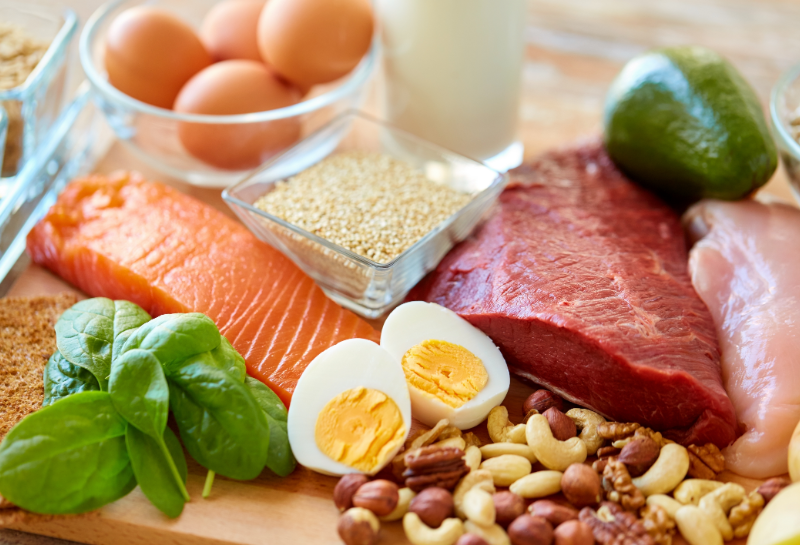
2. Prioritize High-Quality Protein at Every Meal
Older adults benefit from:
- 25–40 grams of protein per meal (not just at dinner)
- Sources rich in leucine, the amino acid that triggers muscle protein synthesis
Timing matters: Spreading protein across breakfast, lunch, and dinner appears more effective than consuming most of it in one meal.
What this looks like in practice:
Breakfast (25-30g):
- 3 eggs scrambled with cheese + toast = 28g
- Greek yogurt (1 cup) + 1/4 cup nuts = 27g
- Protein smoothie with powder, banana, almond butter = 30g
Lunch (25-35g):
- Grilled chicken (4 oz) on salad with chickpeas = 35g
- Tuna (5 oz) with Greek yogurt on whole grain = 32g
- Lentil soup (2 cups) + 2 hard-boiled eggs = 28g
Dinner (30-40g):
- Salmon (5 oz) + quinoa + vegetables = 38g
- Lean beef stir-fry (4 oz) with tofu = 35g
- Shrimp (6 oz) over pasta = 36g
Practical tips:
- Prep protein in bulk: grill 3-4 chicken breasts on Sunday
- Keep convenient options on hand: canned fish, hard-boiled eggs, Greek yogurt, rotisserie chicken
- For plant-based eaters: combine legumes + grains + nuts/seeds for complete amino acids
Cost-effective options:
- Eggs (~$0.20-30 each, complete protein)
- Canned tuna/salmon ($1-3 per can)
- Chicken thighs (less expensive than breasts)
- Dried beans and lentils (pennies per serving)
- Greek yogurt and cottage cheese in bulk
3. Include Short Intensity Bursts
Brief bursts of high effort—just 20–30 seconds—recruit fast-twitch muscle fibers, which decline more rapidly with age.
Simple options:
- Climbing stairs quickly (then resting)
- Fast marching in place
- Controlled sprint intervals on a bike
- Kettlebell swings (if appropriate)
You don’t need to train like an athlete. One or two short bursts during a walk can make a difference. These powerful muscle fibers respond to intensity, not duration.
How to implement safely:
If you’re just starting:
- During your regular walk, pick up the pace for 20-30 seconds every 5 minutes
- Walk up a gentle incline or a few stairs at a brisk pace
- March in place lifting knees higher than usual for 20 seconds
- Do 5-10 quick step-ups on a low step
If you’re more experienced:
- Sprint up a flight of stairs, walk down slowly (repeat 3-5 times)
- Fast-paced cycling intervals: 30 seconds hard, 2 minutes easy (repeat 4-6 times)
- Jump rope for 20-30 seconds (if joints permit)
- Medicine ball slams or throws
Key principles:
- Always warm up first with 5-10 minutes of easy movement
- The effort should feel challenging but controlled
- You should be able to recover within 1-2 minutes
- Start with 2-3 bursts per session, build to 5-8
- Do this 1-2 times per week (not every day)
Why this matters for longevity: Fast-twitch fibers are what help you catch yourself during a stumble, get up quickly from a chair, or react fast in an emergency. They’re your insurance policy against falls and your ticket to staying independent.
These fibers atrophy faster than slow-twitch endurance fibers. Walking and steady cardio maintain your slow-twitch fibers—excellent for heart health—but only brief, intense efforts preserve the fast-twitch fibers that protect against falls and maintain explosive strength.
4. Protect Your Sleep
Muscle repair happens during deep sleep. Period.
Chronic sleep restriction elevates cortisol (a catabolic hormone that breaks down muscle) and impairs recovery. Even perfect training and nutrition can’t overcome consistently poor sleep.
Aim for 7–9 hours, with focus on:
- Consistent sleep and wake times (even on weekends)
- Cool, dark bedroom (65-68°F is ideal)
- Limited screen exposure before bed (blue light suppresses melatonin)
- Managing stress that disrupts sleep quality
If you’re struggling with sleep:
Evening routine (2-3 hours before bed):
- Dim the lights progressively (signals circadian rhythm)
- Stop eating 2-3 hours before bed (digestion interferes with deep sleep)
- Avoid alcohol (disrupts sleep architecture even if it makes you drowsy)
- Try magnesium glycinate supplement (200-400mg with dinner, if cleared by your doctor)
Sleep environment optimization:
- Blackout curtains or sleep mask
- White noise machine or fan (blocks disruptive sounds)
- Cool room temperature (your core body temperature needs to drop to sleep)
- Comfortable mattress and pillows (no heroics—invest in comfort)
If you wake frequently:
- Empty your bladder before bed
- Avoid fluids 2 hours before sleep
- Address sleep apnea if snoring is an issue (huge muscle recovery factor)
- Consider testing for low testosterone or thyroid issues if sleep problems persist
The muscle-sleep connection: Growth hormone—critical for muscle repair—pulses during deep sleep stages. Consistently getting less than 6 hours can reduce this by up to 30%. You’re literally sleeping away your muscle-building potential.
Poor sleep also increases cortisol, which directly breaks down muscle tissue for energy. You can train perfectly and eat ideally, but without adequate sleep, you’re fighting a losing battle.

5. Stay Consistent
Here’s the hard truth: muscle is metabolically expensive tissue. Your body will reduce it the moment it’s no longer being used.
Missing a week? You’ll be fine. Missing a month? You’ll notice regression.
Consistency trumps perfection. Two focused 20-minute sessions per week will always beat sporadic intense workouts. Build the habit first. Optimize the program second.
Why Muscle Is Your Longevity Insurance
Muscle isn’t just about strength—it’s a metabolic organ that protects nearly every system in your body.
Higher muscle mass correlates with:
- Lower all-cause mortality risk
- Improved insulin sensitivity (reduced diabetes risk)
- Better bone density (muscle pulls on bone, strengthening it)
- Reduced fall risk (strength protects balance)
- Greater functional independence (the ability to live on your terms)
Loss of muscle mass is one of the strongest predictors of frailty. Conversely, preserving muscle preserves resilience, autonomy, and quality of life.
Think of every strength session as a deposit in your future health account.
A Simple 7-Day Starter Plan
Week 1: Build the Habit
Day 1: Foundation Strength (15-20 minutes)
- Warm-up: 5 minutes walking/marching
- Sit-to-stand: 3 sets of 8-10 reps (60 sec rest between sets)
- Wall push-ups: 3 sets of 8-10 reps
- Counter-assisted squats: 2 sets of 8 reps
- Cool-down: 3-5 minutes stretching
Focus: Learn the movements. Rest as needed.
Day 2: Active Movement + Bursts (20-25 minutes)
- 20-minute brisk walk (can talk but slightly challenged)
- Add 3 intensity bursts: pick up pace for 30 seconds at minutes 5, 10, and 15
- Alternative: Walk up stairs or an incline at these intervals
Focus: Notice how bursts feel—challenging but recoverable within a minute.
Day 3: Rest or Mobility (10-15 minutes)
- Light stretching (hips, shoulders, hamstrings)
- Gentle yoga, tai chi, or easy neighborhood walk
- Or complete rest
Focus: Active recovery without strain.
Day 4: Strength Session #2 (15-20 minutes)
- Warm-up: 5 minutes
- Sit-to-stand: 3 sets of 10 reps (1-2 more than Day 1)
- Wall push-ups: 3 sets of 10 reps
- Bodyweight squats: 2 sets of 10 reps
- Balance: Stand on one foot, hold counter: 30 sec each leg
- Cool-down: Stretching
Focus: Add 1-2 reps if possible.
Day 5: Light Activity (15-30 minutes)
- Leisurely walk, bike, swim, or gardening
- Any movement you enjoy—this isn’t training, it’s active living
Focus: Enjoyable movement.
Day 6: Strength Session #3 (15-20 minutes)
- Warm-up: 5 minutes
- Sit-to-stand: 3 sets of 10-12 reps (hold light objects if ready)
- Wall or countertop push-ups: 3 sets of 10-12 reps
- Squats: 3 sets of 10 reps
- Step-ups on bottom stair: 2 sets of 6 per leg
- Cool-down: Stretching
Focus: Notice improvements from Day 1.
Day 7: Full Recovery
- Complete rest or gentle movement
- Hit protein targets at each meal
- Prioritize 7-9 hours of sleep
- Reflect: what worked, what to adjust next week
Focus: Recovery is training. Muscles grow during rest.
Week 2 and Beyond: Repeat this pattern, aiming each week for 1-2 more reps, slightly harder variations, or one additional set on comfortable exercises.
Track sessions in a notebook: date, exercises, reps/sets, how you felt. Seeing progress on paper motivates when physical changes take time.

Common Obstacles and Solutions
“I don’t have time”
Reality: You need 20-30 minutes, 2-3 times per week. That’s 1% of your week.
Solution: Frame it as non-negotiable healthcare. Wake up 30 minutes earlier twice a week, or use half your lunch break. Time isn’t found—it’s prioritized.
“I’m too tired”
Solution: Start with just 10 minutes. Often you’ll find momentum once you begin. If genuinely exhausted, do a lighter session—half the sets. Also evaluate sleep and nutrition—chronic fatigue signals these need attention first.
“I’m afraid of getting injured”
Solution: Start conservatively. Pain is your signal—dull muscle fatigue is normal; sharp joint pain means stop and adjust. Consider 2-3 sessions with a physical therapist to learn form. Injury risk from NOT training (falls, fractures) vastly exceeds risk from proper progressive training.
“I don’t see results fast enough”
Reality: You’ll feel stronger in 2-3 weeks. Measurable strength gains appear in 4-6 weeks. Visible muscle changes take 8-12 weeks.
Solution: Track performance metrics, not just appearance. Can you do more reps? Stand up easier? Carry groceries with less strain? These functional improvements arrive much sooner than aesthetic changes.
“My joints hurt”
Key distinction: Muscle soreness (dull, achy, improves with movement) vs. joint pain (sharp, specific, worsens with movement).
Solution: For muscle soreness—continue with lighter loads. For joint pain—stop the aggravating exercise, reduce range of motion, try variations. Persistent joint pain needs medical evaluation.
“I keep starting and stopping”
Solution: Reduce barriers. Lay out workout clothes the night before. Do it at the same time each session. Find an accountability partner. Make it easier to do the workout than to skip it.
Frequently Asked Questions
At what age does muscle loss start?
Muscle loss begins subtly in the 30s but accelerates significantly after 50, particularly without regular resistance training. The rate of loss increases with inactivity. https://www.nia.nih.gov/news/how-can-strength-training-build-healthier-bodies-we-age
Can you build muscle after 60?
Absolutely. Research consistently shows that adults in their 60s, 70s, and even 80s can increase both strength and muscle mass with structured resistance training. Adaptation may take longer, but it happens. https://pubmed.ncbi.nlm.nih.gov/8190152/
How much protein do adults over 50 need?
While individual needs vary, many experts recommend 1.2–1.6 grams of protein per kilogram of body weight per day for active older adults. For a 150-pound (68 kg) adult, that’s roughly 80–110 grams daily, spread across meals. https://pubmed.ncbi.nlm.nih.gov/25646338/
Is walking enough to prevent muscle loss?
Walking is excellent for cardiovascular health, mood, and general fitness, but it doesn’t provide sufficient resistance stimulus to maintain or build muscle. You need resistance training to preserve muscle mass.
Do hormones need to be optimized to rebuild muscle?
Hormonal shifts do affect muscle growth potential, but resistance training remains highly effective even with age-related hormonal decline. Focus on what you can control: training stimulus, protein intake, sleep, and consistency.
When should I see a doctor or physical therapist?
See a doctor before starting if you:
- Have a history of heart disease, high blood pressure, or diabetes
- Experience chest pain, dizziness, or shortness of breath with activity
- Have severe arthritis or joint problems
- Haven’t exercised in years and are over 65
- Take medications that affect balance or heart rate
See a physical therapist if you:
- Have chronic pain that limits movement
- Are recovering from injury or surgery
- Need help learning proper form
- Have balance issues or fall risk
- Want a customized program for specific limitations
A few sessions with a professional can prevent months of mistakes and accelerate progress safely.

Final Thoughts
Muscle loss after 50 is common. It is not your destiny.
Your body still responds to stimulus, protein, recovery, and consistency—even decades after your physical peak. The cellular machinery is intact. The adaptation potential remains.
What changes is the margin for error. You can’t coast. You can’t rely on what worked in your 30s.
But with focused effort—resistance training twice a week, adequate protein at each meal, quality sleep, and patience—you can rebuild strength, preserve independence, and protect the longevity you’re working toward.
Small actions, repeated consistently, compound into something powerful.
The strength you build today isn’t just for today. It’s insurance for the independence, mobility, and vitality you’ll need tomorrow—and for decades to come.
Start small. Start today. Your future self will thank you.

